

/ Immortality Corporation Vision
Dear friends,
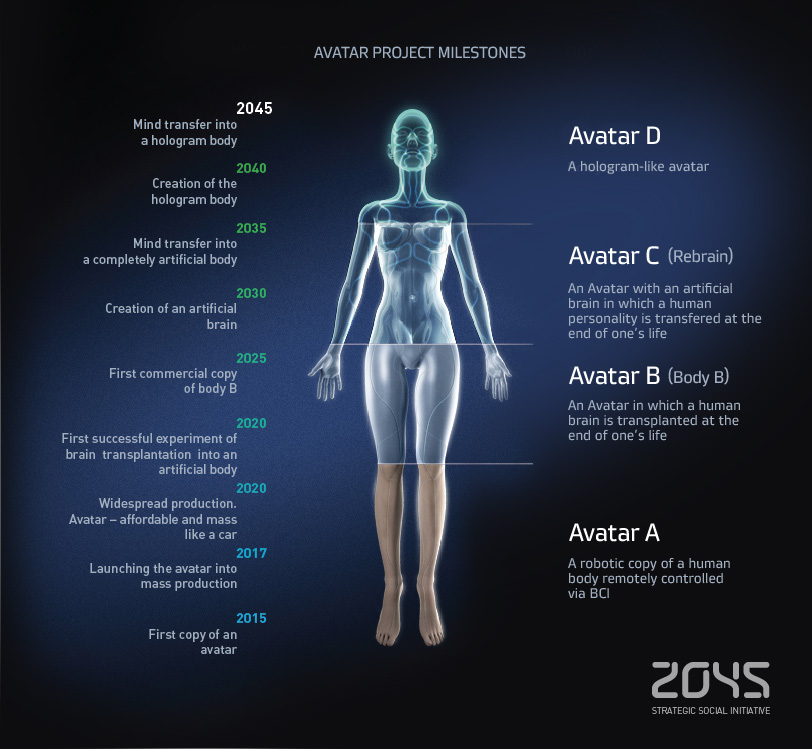
Let me introduce you the Immortality Corporation work schedule.
The schedule is based on the analysis of the already existing research programs of "2045" Initiative Group Members, as well as other scientific communities from Russia and abroad.
Artificial Body Research and Development will be divided into several tracks, to be pursued simultaneously.
The four tracks and their suggested deadlines are optimistic but feasible. This is our program for the next 35 years, and we will do our best to complete it.
The fourth development track seems the most futuristic one. It’s intent is to create a holographic body. Indeed, its creation is going to be the most complicated task, but at the same time could be the most thrilling problem in the whole of human evolution. Perhaps it is the ‘radiant mankind’ Konstantin Tsiolkovsky wrote about.
We are in the process of creating focus groups of experts. Along with these teams, we will prepare goal statements and research programs schedules.
We invite interested specialists to contact us and join the discussion. We welcome your contribution.
Dmitry ITSKOV

/ experts
- Ph.D. in Chemistry, Head of the Chemical Enzymology Department at the Moscow State University, corresponding member of the Russian Academy of Sciences, Director of the Institute of Biochemical Physics (Russian Academy of Sciences)
 Professor Sergey V.
VARFOLOMEEV‘An electronic version of the brain is needed. The physical brain, in my opinion, can not be a subject of study, since it is very subtle. But an electronic analog having all the receptor equipment and the same story, incentives, motivation - it might be very interesting...’
- Head of the Space Technology and Telecommunications Cluster at the Skolkovo
 Sergey
Jukov"I am absolutely convinced that the movement “2045’ happened exactly at the right time and the right place as I believe in the great future for Russia, in her success after temporary difficulties".
- Researcher, science debater, futurist, transhumanist, and author
 Anders
Sandberg"... I certainly think that practical benefits of being able to live for ever, if I transmit myself digitally, I will be able to run on bodies which are not biological or enhanced biological and be able to backup copies in case, if something goes wrong, would be enormous. So, I think, that in the future I am hoping to be software..."
- PhD, Professor of Oxford University, co-founder (with David Pearce) of the World Transhumanist Association
 Nick
Nick
Bostrom"The digital path [of extreme longevity] would be, if we could develop technology eventually to do human whole brain emulation, where we would create a very detailed model of a particular human brain and then emulate that in the computer, where we would have an indefinite life span potential, we could make backup copies and so forth..."
- Ph.D. in Technical Sciences
 Professor Aleksandr A.
BOLONKIN‘An artificial mechanical body will have great power and withstand extreme environmental conditions: high temperature, pressure, radiation, space...’
- Professor, head of the laboratory in the Institute of Higher Nervous Activity and Neurophysiology RAS
 Alexander A.
Frolov‘The problem of creating artificial memory devices capable of storing the natural memory of a given individual is, understandably, complex but by no means unsolvable...’
- Professor at the University of Southern Maine, co-chairman of GF2045
 Barry
Barry
Rodrigue"While innovation is often presented as a technological process, it also needs to be applied everywhere and to everything. We need innovation in human affairs, from family relations to business affairs. Innovation has to address both ecological balance of species and destruction of inorganic habitats. Alternatives must be found for warfare and the arms industry. In short, innovation is a process that applies to all existence..."
- Ph.D. in Physical and Mathematical Sciences, Senior Researcher of the Heat-Resistant Thermoplastics Laboratory at ISPM (Russian Academy of Sciences), creator of nanosensor neurologic ‘Electronic nose’ system
 Mikhail Y.
YABLOKOV‘When creating an artificial human, we need to add an emotional trend to the predominant robotics one. It’s an all-inclusive idea, and it’s in the air...’
- Ph.D. in Biology, Head of the Neurophysiology and Neural Interfaces Lab at the Russian State University Biology Department (MGU)
 Professor Alexander Y.
KAPLAN‘By the time sustaining a brain artificially becomes possible, bio-robots will have been perfected to the point of looking like a decent human body...’
- Ph.D. in Biology, Inventor of the "Bioartificial liver" device
 Professor Vyacheslav Y.
RYABININ - Doctor of philosophy, professor
 Sergei V.
KrichevskiyOne temporary solution, in my opinion, is to create a “cosmic person”, and start doing so on Earth, within the “future person” project, as part of the “Russia 2045” Initiative.
- Ph.D. in Physical and Mathematical Sciences, Senior Researcher of the V.I.Il`ichev Pacific Oceanological Institute (Russian Academy of Sciences), composer, philosopher
 Viktor Yurievich
Argonov“I think that before initiating a radical cyborgization of the brain, you have to find the neural correlate of consciousness. Does it have a physical or purely informational nature in the form of neurosignals? Is there a group of neurons that is directly responsible for consciousness? Or perhaps consciousness is produced by still smaller elements within neurons. . . .”


/ Follow us at:

/ Contact:
For additional information, partnerships and sponsorship, contact:
info@2045.com
Media requesting information and interviews, contact PR@2045.com
 LinkedIn
 LiveJournal
 Google
 Twitter
 Facebook
 Я.ру
Я.ру
 ВКонтакте
 Mail.ru